Welcome to The Alternative Story!

Tools for Studying English: Synonyms
📘🔍 If you pick up a dictionary, you are likely to find the synonyms of a word alongside its definition. But what exactly is a synonym?
A synonym is “a word that means the same or nearly the same as another word”.
By knowing your synonyms, you can show DIFFERENT INTENSITIES of the SAME action, which can help paint a better picture of the scene that you are describing.
For instance, ‘small’ and ‘tiny’ are synonyms, but the word ‘tiny’ implies a degree of relative intensity compared to the neutral ‘small’.
💡 Synonyms can be useful in both Composition Writing and PSLE English Oral, showcasing greater language proficiency. They signal to the examiner that you have an extensive vocabulary bank, and a good grasp of the English language!
Now, let’s use the words ‘UPSET’ vs ‘BELLICOSE’ as another example.
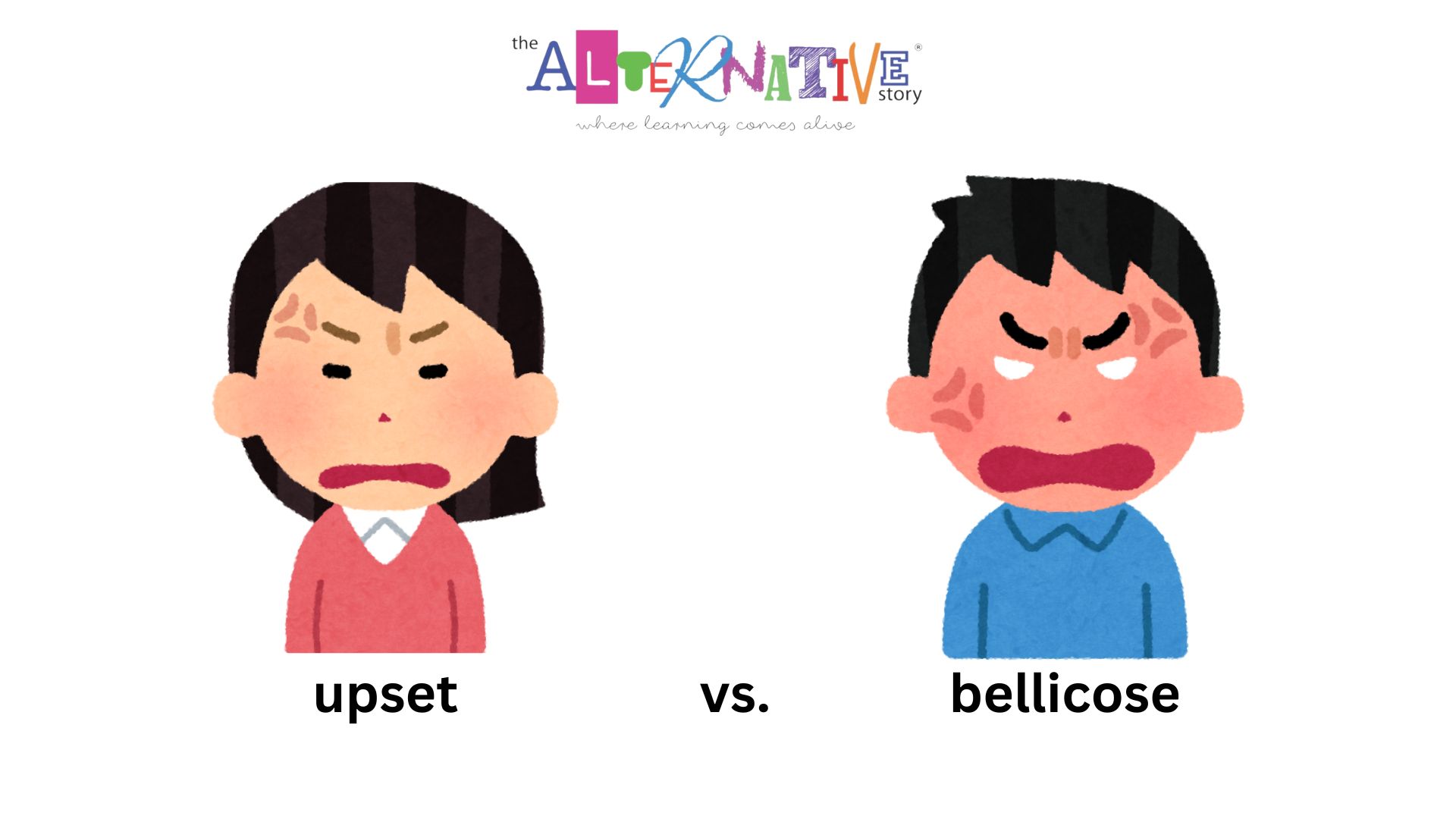
UPSET 😠
💭 “The angry man was UPSET when he saw his uncooked food and scolded the waitress.”
The example shows a man who is upset because his food is uncooked. It seems he has reason to be upset.
BELLICOSE 😡
💭 “The BELLICOSE man was livid when he saw his food and went off in a tirade.”
This example, however, shows a man who is unreasonable. The word bellicose tells you he is already a bad-tempered man and ‘going off in a tirade’ portrays a man who rants and raves over something as simple as food.
📚 Now, grab your nearest dictionary (online is also OK) and try forming some of your own sentences with synonyms! You can even bring them to class and ask our English teachers at The Alternative Story about some of the sentences that you have created. Have fun! ✨